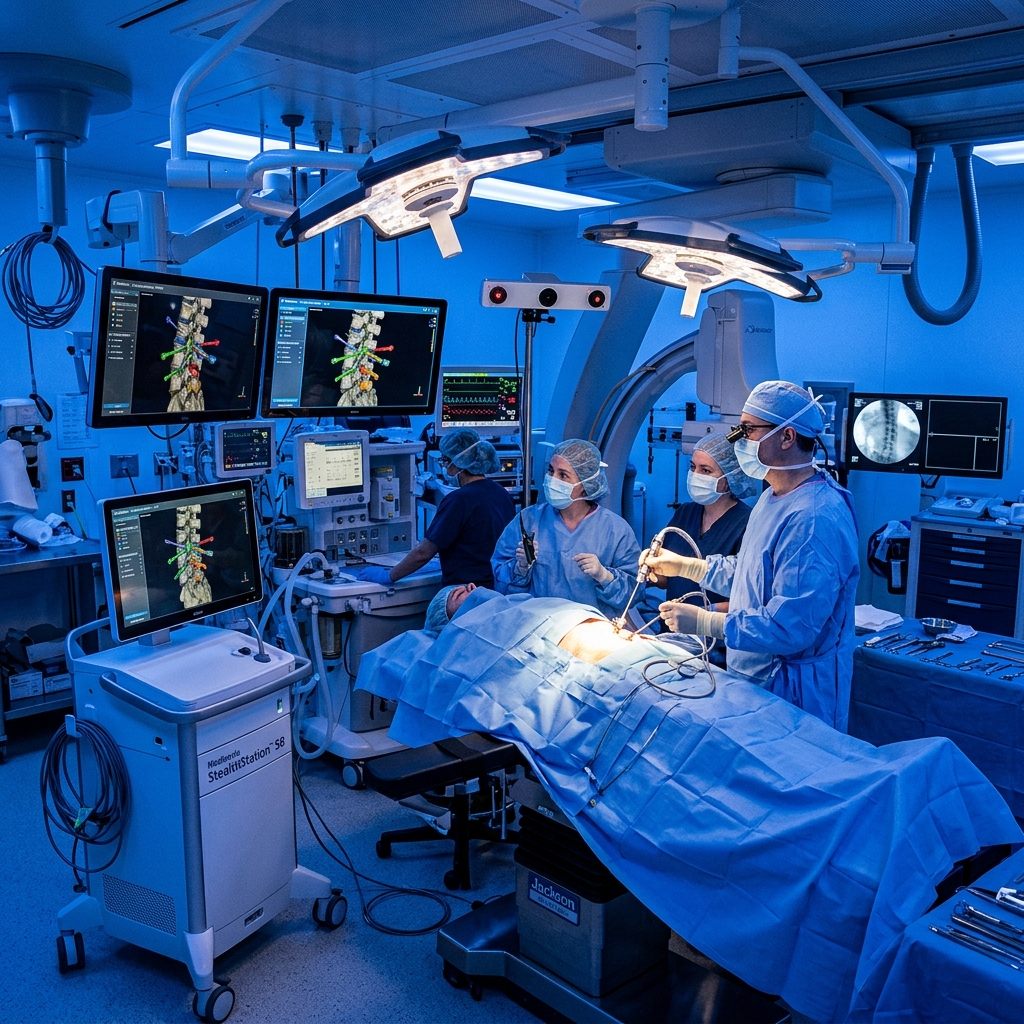
Spine Trauma, Accident & Fracture Care in Indore
Emergency & Minimally Invasive Treatment of Spinal Injuries, Vertebral Fractures & Spinal Cord Injury
Spine trauma — from road traffic accidents, falls, and sports injuries — can range from stable vertebral fractures to spinal cord injury requiring emergency surgery. Dr. Sparsh Jaiswal provides comprehensive spine trauma and accident care at Apollo Hospitals, Indore, using minimally invasive percutaneous fixation, cement augmentation (vertebroplasty/kyphoplasty), and modern fracture-classification systems to stabilise the spine, protect the spinal cord, and restore mobility with minimal blood loss and early recovery.
Key Facts
- check_circleIndia records the highest number of road-accident deaths in the world — spinal injuries are a common and serious consequence.
- check_circleVertebral fractures are classified as stable or unstable; unstable fractures and any neurological deficit need urgent surgical stabilisation.
- check_circleMinimally invasive percutaneous screw fixation reduces blood loss to under 100 mL compared with 500–1000 mL in open surgery.
- check_circleOsteoporotic compression fractures can be treated with vertebroplasty or kyphoplasty — providing pain relief within 24–48 hours.
- check_circleThe "golden hour" matters: rapid assessment and spinal stabilisation reduce the risk of permanent paralysis.
Why Specialised Spine Trauma Care Matters
A spinal injury after an accident is a race against time. Whether the injury is a stable compression fracture or an unstable fracture-dislocation threatening the spinal cord, the speed and precision of the first intervention often determine whether a patient walks again. Dr. Sparsh Jaiswal combines emergency trauma protocols with minimally invasive fixation techniques to stabilise injuries quickly, decompress the spinal cord when needed, and get patients moving early — all with the smallest possible surgical footprint.
24/7 Emergency Spine Response
Rapid assessment and stabilisation of acute spinal injuries at Apollo Hospitals, Indore — with the trauma, imaging, and ICU infrastructure of a leading tertiary centre.
Minimally Invasive Fixation
Percutaneous pedicle screw fixation stabilises fractures through small incisions — reducing blood loss to under 100 mL and lowering infection and ICU-stay risk versus open surgery.
Cement Augmentation
Vertebroplasty and kyphoplasty stabilise osteoporotic and selected traumatic compression fractures, providing rapid pain relief — often within 24–48 hours.
Spinal Cord Protection
Urgent decompression and realignment to relieve pressure on the spinal cord — maximising the chance of neurological recovery after spinal cord injury.
Early Mobilisation
Minimally invasive stabilisation allows patients to begin sitting and walking sooner — reducing the complications of prolonged bed rest.
Evidence-Based Classification
Treatment decisions guided by validated systems (TLICS, AO Spine) to match each fracture to the optimal — and least invasive — treatment.
Considering Minimally Invasive Spine Trauma Stabilisation?
Dr. Sparsh Jaiswal will review your case personally and tell you whether this is the right option for you. Book a consultation or message on WhatsApp — same-day responses.
Minimally Invasive vs. Open Trauma Surgery
| starMinimally Invasive Fixation | Conventional Open Surgery | |
|---|---|---|
| Incision | Several sub-centimetre incisions | Large midline incision |
| Blood loss | < 100 mL | 500–1000+ mL |
| Muscle damage | Muscle-sparing — fibres spread, not cut | Muscle stripping from bone |
| Infection risk | Lower | Higher |
| ICU / hospital stay | Shorter | Longer |
| Time to mobilisation | Early — often next day | Delayed |
| Post-op pain | Reduced | Significant |
Spinal Injuries We Treat
check_circleSuitable For
- Vertebral compression, burst, and fracture-dislocation injuries
- Road traffic accident (RTA) and high-energy fall injuries
- Spinal cord injury with weakness, numbness, or paralysis
- Osteoporotic vertebral fractures in elderly patients
- Sports-related spine injuries and pars stress fractures
- Pathological fractures through tumour-weakened bone
infoMay Not Be Suitable When
- Minor soft-tissue strains without bony or neural injury (managed conservatively)
- Stable fractures without deformity or neurological deficit (often braced, not operated)
How It Works — Step by Step
Emergency Assessment & Imaging
Immediate ATLS-based trauma evaluation, spinal immobilisation, and rapid CT/MRI to characterise the fracture, assess spinal cord involvement, and grade instability.
Fracture Classification
The injury is graded using validated systems (TLICS, AO Spine) to decide between bracing, cement augmentation, or surgical fixation — and to determine urgency.
Spinal Cord Decompression
Where the spinal cord or nerves are compressed, urgent decompression relieves pressure to maximise the chance of neurological recovery.
Minimally Invasive Stabilisation
Percutaneous pedicle screws or cement augmentation stabilise the spine through small incisions — restoring alignment with minimal blood loss and tissue damage.
Rehabilitation & Recovery
Early mobilisation, bracing where needed, bone-health optimisation (for osteoporotic fractures), and a structured physiotherapy programme to restore function.
Related Conditions & Procedures
Frequently Asked Questions
What should I do immediately after a spinal injury from an accident?
Do not move the injured person unnecessarily — keep the head, neck, and back aligned and call emergency services. Avoid twisting or bending the spine. Rapid, careful immobilisation and transfer to a hospital with spine-trauma capability is critical, because correct early handling can prevent a spinal injury from worsening into permanent paralysis. For spine emergencies in Indore, call +91 8450888766.
When does a spinal fracture need surgery?
Surgery is needed when a fracture is unstable (at risk of further displacement or cord injury), when there is any neurological deficit (weakness, numbness, or bladder/bowel dysfunction), or when there is significant deformity. Stable fractures without neurological involvement are often managed with bracing; painful osteoporotic compression fractures may be treated with vertebroplasty or kyphoplasty.
What is minimally invasive (percutaneous) fixation for spine fractures?
Percutaneous fixation stabilises a fractured spine using pedicle screws and rods inserted through several small (sub-centimetre) incisions, guided by imaging — without the large incision and muscle stripping of open surgery. Blood loss is typically under 100 mL versus 500–1000 mL in open surgery, infection risk is lower, and patients mobilise sooner.
Can a spinal cord injury be reversed?
Outcomes depend on the severity and how quickly pressure on the cord is relieved. Urgent surgical decompression and stabilisation — ideally as early as possible — give the best chance of neurological recovery. While complete spinal cord injuries have limited recovery potential, incomplete injuries treated promptly can recover significant function. Early specialist care is essential.
How are osteoporotic spine fractures treated?
Many osteoporotic vertebral compression fractures heal with bracing and bone-strengthening medication. When pain persists, vertebroplasty or kyphoplasty — injecting medical bone cement into the collapsed vertebra under imaging guidance — provides rapid pain relief, often within 24–48 hours. Treating the underlying osteoporosis is essential to prevent further fractures.
How common are spine injuries in road accidents in India?
India records the highest number of road-traffic-accident deaths in the world, and spinal injuries are a frequent and serious consequence — particularly of two-wheeler accidents and falls. The thoracolumbar junction (lower chest to upper lumbar spine) is the most commonly injured region. Prompt, specialised spine-trauma care significantly improves outcomes.
How quickly should spine trauma be treated?
Spine trauma with neurological symptoms is a surgical emergency — the "golden hour" principle applies. Rapid assessment, imaging, and stabilisation reduce the risk of permanent damage. Even without neurological symptoms, unstable fractures should be evaluated urgently. Dr. Sparsh Jaiswal provides emergency spine-trauma care at Apollo Hospitals, Indore.
Where can I get emergency spine trauma care in Indore?
Dr. Sparsh Jaiswal provides emergency and minimally invasive spine-trauma care at Apollo Hospitals, Vijay Nagar, Indore — a tertiary centre with full trauma, imaging, and ICU infrastructure. For spine emergencies, call +91 8450888766 at any time.
verified_userMedically reviewed: May 2026 — Dr. Sparsh Jaiswal, MBBS DNB FISS FINM MNAMS · Consultant Spine Surgeon, Apollo Hospitals, Indore (Reg: MP-16286 | MCI-19-30548)
Speak with Dr. Sparsh Jaiswal
Book a consultation to find out whether this approach is right for you. Same-day emergency assessments available for spine trauma.