Awake Spine Surgery in Indore
Endoscopic & Minimally Invasive Spine Surgery Without General Anaesthesia
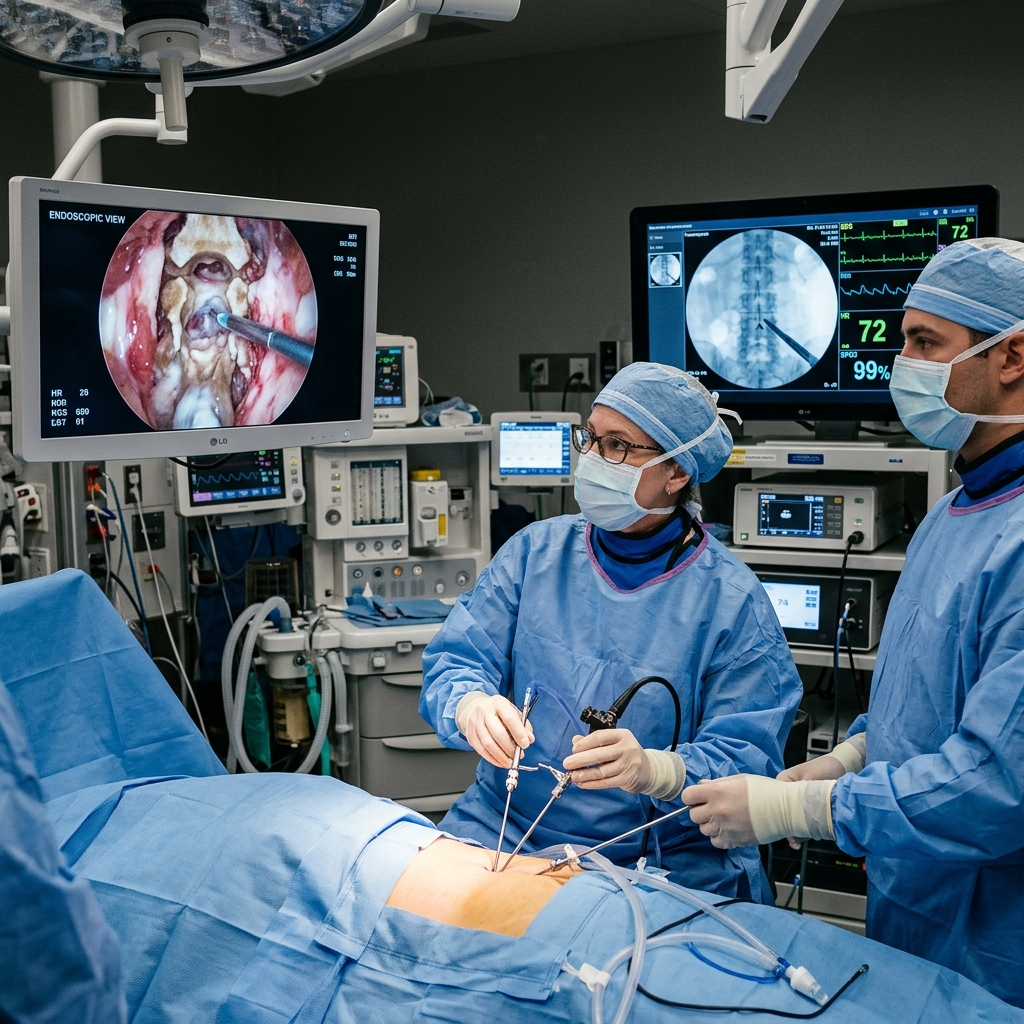
Awake spine surgery is a technique in which spinal procedures — most commonly endoscopic discectomy and minimally invasive fusion — are performed under spinal, epidural, or local anaesthesia with light sedation, instead of general anaesthesia. The patient stays comfortable and breathing on their own throughout. Dr. Sparsh Jaiswal performs awake endoscopic spine surgery at Apollo Hospitals, Indore, allowing many patients — including the elderly and those with heart, lung, or diabetic conditions — to undergo spine surgery safely and go home the same day.
Key Facts
- check_circlePerformed under spinal / epidural / local anaesthesia with conscious sedation — no general anaesthesia and no breathing tube.
- check_circleIdeal for elderly patients and those at high anaesthetic risk (cardiac, pulmonary, diabetic, or obese patients).
- check_circleReal-time patient feedback during surgery reduces the risk of nerve injury.
- check_circleMost awake endoscopic procedures take 45–90 minutes with same-day or next-day discharge.
- check_circleMinimal blood loss, no post-anaesthesia nausea, and faster return to normal activity.
Why Choose Awake Spine Surgery?
General anaesthesia carries real risks — particularly for older patients and those with heart, lung, or metabolic conditions. Awake spine surgery removes that risk entirely while preserving the precision of modern endoscopic and minimally invasive techniques. Because the patient is conscious, they can give real-time feedback if a nerve is touched — a built-in safety mechanism that general anaesthesia cannot provide.
No General Anaesthesia Risk
Eliminates the risks of intubation, ventilation, and general anaesthesia — opening safe surgery to patients previously told they were "too high-risk to operate".
Real-Time Nerve Protection
Because you are awake, you can immediately report any leg sensation if a nerve is approached — allowing instant course-correction and dramatically lowering nerve-injury risk.
Ideal for Elderly & High-Risk Patients
Cardiac, pulmonary, diabetic, and obese patients who cannot tolerate general anaesthesia can safely undergo spine surgery under regional anaesthesia.
Same-Day Mobilisation
Most patients walk within 2–4 hours of surgery and are discharged the same day or the next morning.
No Anaesthesia Hangover
No post-operative grogginess, nausea, vomiting, or sore throat from a breathing tube — patients eat and talk normally within hours.
Lower Overall Cost
Shorter operating time, no ICU requirement, and same-day discharge reduce the total cost of treatment compared with conventional open surgery under general anaesthesia.
Considering Awake Endoscopic Spine Surgery?
Dr. Sparsh Jaiswal will review your case personally and tell you whether this is the right option for you. Book a consultation or message on WhatsApp — same-day responses.
Awake Surgery vs. Conventional Surgery Under General Anaesthesia
| starAwake Spine Surgery | Conventional (General Anaesthesia) | |
|---|---|---|
| Anaesthesia | Spinal / epidural / local + light sedation | General anaesthesia with breathing tube |
| Suitable for high-risk patients | Yes — elderly, cardiac, pulmonary, diabetic | Often refused as "unfit for surgery" |
| Nerve-injury safeguard | Real-time patient feedback | No conscious feedback possible |
| Post-op nausea / grogginess | Minimal to none | Common |
| Typical hospital stay | Same day – 1 night | 3–5 days |
| Blood loss | < 20–50 mL | 200–500+ mL |
| Return to light activity | 3–7 days | 4–6 weeks |
Are You a Candidate for Awake Spine Surgery?
check_circleSuitable For
- Lumbar disc herniation (slipped disc) with sciatica not responding to medication
- Lumbar canal stenosis causing leg pain and walking difficulty
- Single or two-level degenerative spine disease requiring decompression or fusion
- Elderly patients (often 65+) considered high-risk for general anaesthesia
- Patients with heart disease, lung disease, uncontrolled diabetes, or obesity
- Patients who previously avoided surgery due to anaesthesia fears
infoMay Not Be Suitable When
- Complex multi-level deformity correction requiring prolonged surgery
- Severe anxiety where the patient cannot stay still while awake
- Certain high spinal-cord-level (cervical/thoracic) pathologies — assessed case-by-case
- Allergy or contraindication to regional/spinal anaesthetic agents
How It Works — Step by Step
Pre-operative Assessment
Detailed evaluation with MRI review, anaesthetic fitness assessment, and a clear explanation of what you will experience while awake. Most patients find this reassuring once they understand the process.
Regional Anaesthesia
A spinal, epidural, or local anaesthetic block numbs the surgical area completely. Light conscious sedation keeps you relaxed and comfortable — you feel no pain, only mild pressure at most.
Endoscopic / MIS Procedure
Through a 7–8 mm incision, Dr. Jaiswal performs the decompression or fusion under HD endoscopic visualisation. You remain comfortable and can communicate with the surgical team throughout.
Real-Time Feedback
If a nerve is approached, you simply report the sensation — allowing immediate adjustment. This live feedback loop is the single biggest safety advantage of staying awake.
Early Mobilisation & Discharge
With no general anaesthetic to recover from, you can sit up, eat, and walk within a few hours. Most patients are discharged the same day or the following morning.
Related Conditions & Procedures
Frequently Asked Questions
Will I feel pain during awake spine surgery?
No. The surgical area is completely numbed by a spinal, epidural, or local anaesthetic block, and you receive light sedation to keep you calm and comfortable. Patients typically feel only mild pressure, not pain. You remain aware enough to communicate with the surgical team but relaxed throughout.
Why would I stay awake instead of being put to sleep?
Staying awake removes all the risks of general anaesthesia — which is especially valuable for elderly patients and those with heart, lung, or diabetic conditions. It also adds a unique safety advantage: if a nerve is approached, you can report the sensation instantly, allowing the surgeon to adjust and avoid nerve injury. Recovery is faster, with no anaesthesia hangover, nausea, or sore throat.
Is awake spine surgery safe?
Yes. For appropriately selected patients, awake spine surgery is very safe and often safer than general anaesthesia — particularly for high-risk patients. The combination of regional anaesthesia, minimally invasive endoscopic technique, and real-time patient feedback makes it one of the safest approaches to spine surgery available today.
Who is the best candidate for awake spine surgery?
The best candidates have single or two-level lumbar pathology — such as a herniated disc, sciatica, or canal stenosis — and benefit most when they are elderly or considered high-risk for general anaesthesia (heart disease, lung disease, uncontrolled diabetes, or obesity). Patients who previously avoided surgery due to anaesthesia fears are often excellent candidates.
How long does awake spine surgery take and when can I go home?
Most awake endoscopic procedures take 45–90 minutes. Because there is no general anaesthetic to recover from, most patients walk within 2–4 hours and are discharged the same day or the next morning.
Can elderly patients have awake spine surgery?
Yes — elderly patients are among the biggest beneficiaries. Many older patients are told they are "too high-risk" for spine surgery because of general anaesthesia concerns. Awake spine surgery under regional anaesthesia removes that barrier, allowing safe treatment of disabling spine conditions even in patients in their 70s and 80s.
What conditions can be treated with awake spine surgery?
Awake spine surgery is most commonly used for lumbar disc herniation (slipped disc), sciatica, lumbar canal stenosis, and single or two-level degenerative spine disease requiring decompression or fusion. Dr. Sparsh Jaiswal assesses each case individually to confirm suitability.
Where can I get awake spine surgery in Indore?
Dr. Sparsh Jaiswal performs awake endoscopic and minimally invasive spine surgery at Apollo Hospitals, Vijay Nagar, Indore. You can book a consultation by calling +91 8450888766 to find out whether you are a candidate.
verified_userMedically reviewed: May 2026 — Dr. Sparsh Jaiswal, MBBS DNB FISS FINM MNAMS · Consultant Spine Surgeon, Apollo Hospitals, Indore (Reg: MP-16286 | MCI-19-30548)
Speak with Dr. Sparsh Jaiswal
Book a consultation to find out whether this approach is right for you. Same-day emergency assessments available for spine trauma.