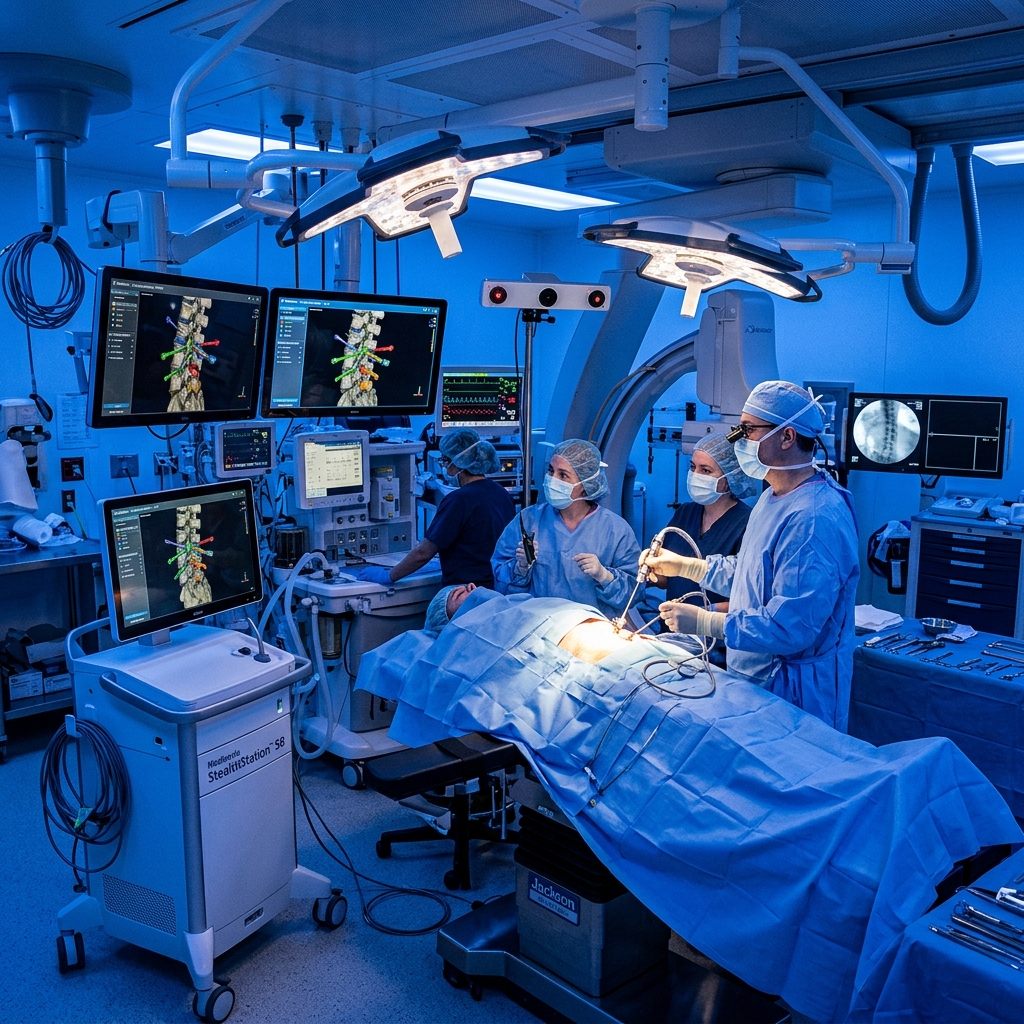
Treatment
Conventional Open Spine Surgery
Conventional open spine surgery remains the gold standard for complex multi-level reconstructions, severe deformity correction, spinal tumour resection, and high-grade fracture management.
About This Treatment
While minimally invasive techniques have transformed spinal surgery for many conditions, complex cases still demand the direct access, wide exposure, and instrumentation capacity that open surgery provides. Multi-level deformity correction, spinal cord tumour resection, revision surgery after MIS failure, and severe trauma are situations where the open approach delivers superior outcomes. Dr. Sparsh Jaiswal's training at premier spinal centres in New Delhi and his fellowship experience equip him to execute these complex reconstructions with the precision and safety that patients deserve. Modern open surgery incorporates intraoperative neuromonitoring, fluoroscopic navigation, and cell salvage to minimise risk.
Key Benefits
- check_circleWidest surgical exposure — ideal for complex multi-level disease
- check_circleMaximum instrumentation options for severe deformity
- check_circleDirect spinal cord visualisation in intramedullary tumour surgery
- check_circleProven long-term outcomes in fusion surgery
- check_circleIntraoperative neuromonitoring standard for all complex cases
Who Is a Candidate?
Indicated for high-grade spondylolisthesis, multi-level stenosis requiring extensive decompression, adult deformity requiring 3-column osteotomy, spinal tumour resection, complex trauma with cord injury, and revision surgery following failed minimally invasive procedures.
The Procedure
Preoperative Planning
Detailed 3D CT/MRI planning. Neuromonitoring strategy, blood bank crossmatch, and multidisciplinary review for complex oncological cases.
Surgical Exposure
Midline or paramedian incision with subperiosteal muscle elevation to expose the target vertebral levels. Self-retaining retractors maintain exposure.
Decompression & Reconstruction
Decompressive laminectomy, discectomy, osteotomy, or tumour resection performed under magnification. Instrumentation (screws, rods, cages) applied.
Bone Grafting & Closure
Autologous iliac crest or local bone graft packed to promote fusion. Layered closure with drain insertion. Wound dressing applied.
Recovery & Outcomes
Hospital stay is typically 4–7 days for complex reconstructions. Spinal brace required for 6–12 weeks. Physiotherapy supervised rehabilitation begins in hospital. Return to desk work in 6–8 weeks; full recovery in 3–6 months depending on extent of surgery.
verified_userMedically reviewed: May 2026 — Dr. Sparsh Jaiswal, MBBS DNB FISS FINM MNAMS · Apollo Hospitals, Indore (Reg: MP-16286)
Frequently Asked Questions about Open Surgery
What is Open Surgery?
While minimally invasive techniques have transformed spinal surgery for many conditions, complex cases still demand the direct access, wide exposure, and instrumentation capacity that open surgery provides. Multi-level deformity correction, spinal cord tumour resection, revision surgery after MIS failure, and severe trauma are situations where the open approach delivers superior outcomes. Dr. Sparsh Jaiswal's training at premier spinal centres in New Delhi and his fellowship experience equip him to execute these complex reconstructions with the precision and safety that patients deserve. Modern open surgery incorporates intraoperative neuromonitoring, fluoroscopic navigation, and cell salvage to minimise risk.
Who is a candidate for Open Surgery?
Indicated for high-grade spondylolisthesis, multi-level stenosis requiring extensive decompression, adult deformity requiring 3-column osteotomy, spinal tumour resection, complex trauma with cord injury, and revision surgery following failed minimally invasive procedures.
What is the recovery after Open Surgery?
Hospital stay is typically 4–7 days for complex reconstructions. Spinal brace required for 6–12 weeks. Physiotherapy supervised rehabilitation begins in hospital. Return to desk work in 6–8 weeks; full recovery in 3–6 months depending on extent of surgery.
Other Treatments
Ready to begin your recovery?
Dr. Sparsh Jaiswal will personally evaluate your case and recommend the most appropriate treatment pathway.