Spinal Condition
Slipped Disc (Herniated Disc) Treatment
Disc Herniation & Disc Prolapse
A slipped or herniated disc occurs when the soft inner gel of a spinal disc pushes through a crack in its outer casing — frequently compressing nearby nerves.
Understanding Slipped Disc
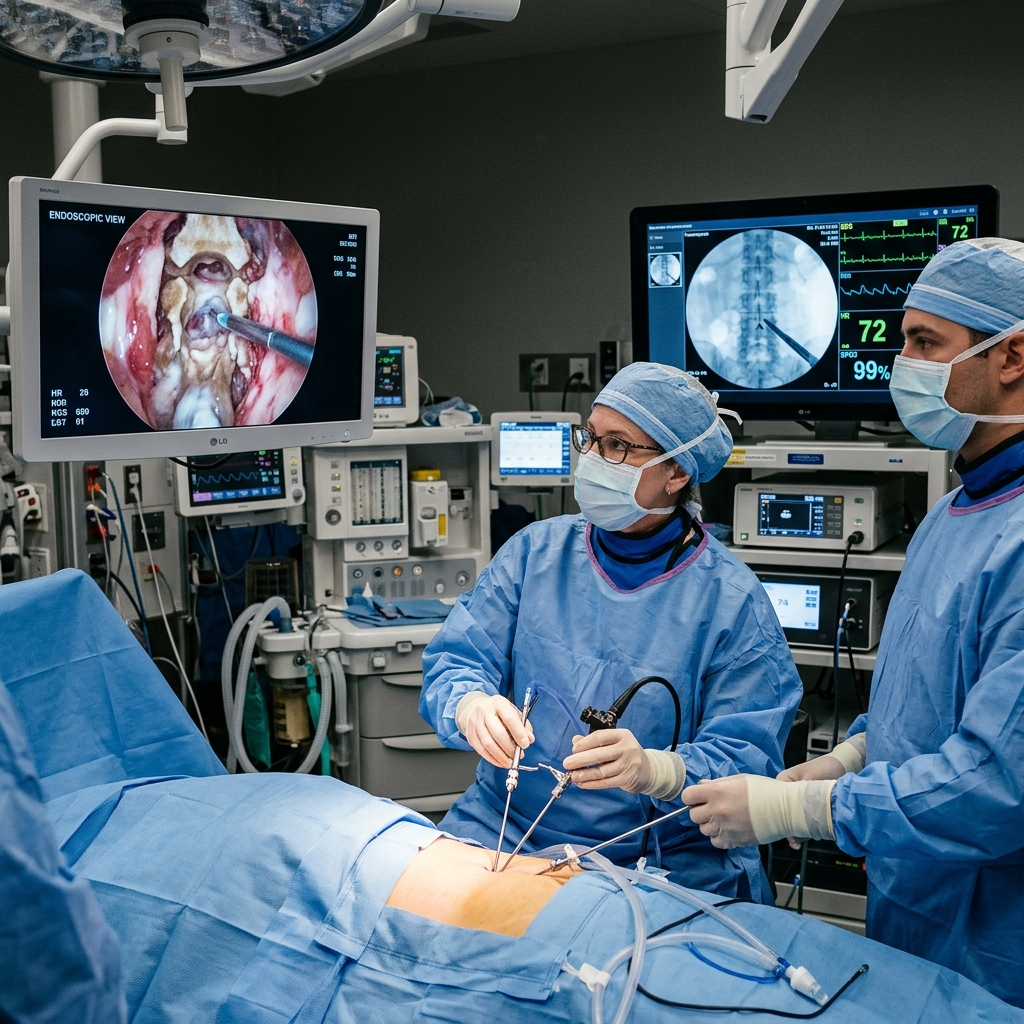
Each spinal disc acts as a shock absorber between vertebrae, with a tough outer ring (annulus fibrosus) and a soft inner core (nucleus pulposus). When the outer ring weakens or tears, the inner material can bulge or rupture outward — a herniated disc. This is most common in the lumbar spine (L4–L5, L5–S1) but also occurs in the cervical spine. Depending on the location and severity, a herniated disc can cause localised pain, radiculopathy (nerve pain into the arm or leg), or neurological deficits. Dr. Sparsh Jaiswal specialises in endoscopic discectomy — removing the herniated fragment through a sub-centimetre incision with same-day recovery.
infoCommon Causes
- Age-related disc degeneration reducing disc hydration and flexibility
- Sudden heavy lifting with improper technique
- Repetitive bending, twisting, or rotational stress
- Obesity increasing axial load on the lumbar discs
- Genetic predisposition to premature disc degeneration
- Trauma from accidents or falls
symptomsKey Symptoms
- check_circleSharp or burning pain in the back radiating to the arm or leg
- check_circleNumbness or tingling in the distribution of the compressed nerve
- check_circleMuscle weakness in movements controlled by the affected nerve
- check_circlePain worsening with sitting, driving, or forward bending
- check_circleIn lumbar herniation: sciatica, foot drop, or difficulty walking
Diagnosis
MRI is the gold standard — it clearly images disc herniation, nerve compression, and the extent of spinal canal compromise. CT myelography is used when MRI is contraindicated.
verified_userMedically reviewed: May 2026 — Dr. Sparsh Jaiswal, MBBS DNB FISS FINM MNAMS · Apollo Hospitals, Indore (Reg: MP-16286 | MCI-19-30548)
Frequently Asked Questions about Slipped Disc
What is the difference between a slipped disc, herniated disc, and disc prolapse?
These terms describe the same condition at different stages. A "slipped disc" is the common name. Medically, the disc does not actually slip — instead, the soft inner nucleus pulposus herniates through a tear in the outer annulus fibrosus. Disc prolapse describes a more advanced stage where the inner material has fully extruded. All three terms are used interchangeably in clinical practice.
Can a herniated disc heal without surgery?
Yes — approximately 80–90% of disc herniations improve without surgery within 6–12 weeks. The herniated material is gradually reabsorbed by the body in a process called spontaneous regression. Conservative treatment (physiotherapy, NSAIDs, and nerve root injections when needed) is the first line. Surgery is considered when neurological deficits are progressive, pain is severe, or conservative treatment fails after 6–12 weeks.
Which level is most commonly affected by a slipped disc?
The L4–L5 and L5–S1 disc levels are most frequently affected — together accounting for over 90% of lumbar disc herniations. L4–L5 herniation typically causes pain and weakness in the foot (foot drop in severe cases); L5–S1 herniation affects the heel and outer foot. Cervical disc herniation most commonly occurs at C5–C6 and C6–C7.
What is endoscopic discectomy and how is it different from open surgery?
Endoscopic discectomy removes the herniated disc fragment through a 7 mm incision under direct HD camera visualisation — without cutting any muscle. Blood loss is under 20 mL and patients walk within 2–4 hours of the procedure. Traditional open microdiscectomy requires a 3–5 cm incision with muscle retraction, a longer hospital stay (2–3 days), and 4–6 weeks recovery. Both achieve equivalent nerve decompression results.
Get expert advice from Dr. Sparsh
Book a consultation to receive an accurate diagnosis and a personalised treatment plan.