Treatment
Minimally Invasive Spine Surgery
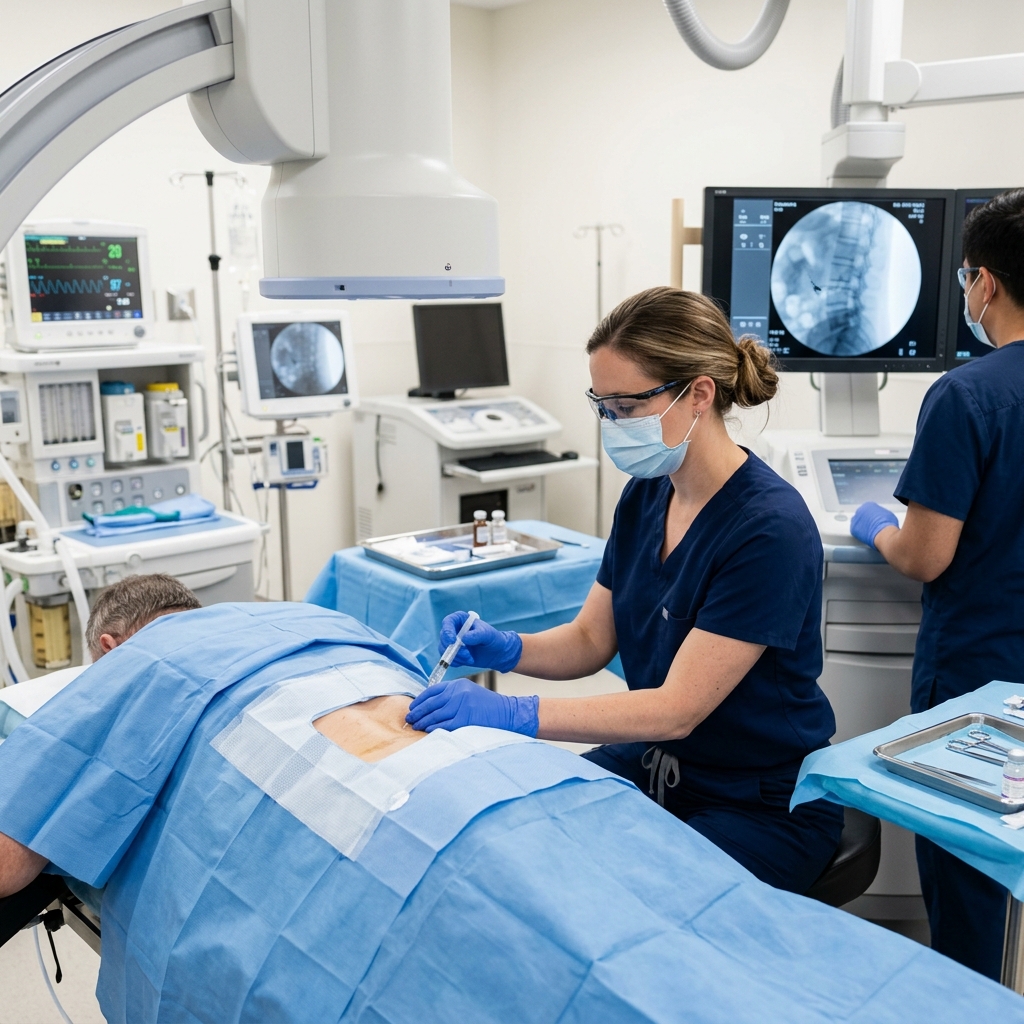
Minimally invasive spine surgery (MIS) encompasses a family of techniques that achieve complex spinal decompression and fusion through small incisions using real-time imaging guidance.
About This Treatment
MIS spine surgery includes percutaneous pedicle screw fixation, lateral lumbar interbody fusion (LLIF/XLIF), transforaminal lumbar interbody fusion (MIS-TLIF), and posterior cervical foraminotomy. These techniques use fluoroscopic navigation, intraoperative CT, or robotic guidance to place implants with sub-millimetre accuracy. Dr. Sparsh Jaiswal completed his spine surgery fellowship at IBS Hospitals, New Delhi — an advanced MIS centre — and has expertise in the full MIS surgical spectrum for both degenerative and traumatic spinal conditions.
Key Benefits
- check_circlePercutaneous implant placement — no open wound over the spine
- check_circleFluoroscopic or robotic navigation ensures precise screw placement
- check_circleMinimal blood loss — often < 50 mL for single-level procedures
- check_circlePreservation of posterior spinal musculature and stability
- check_circleEarlier mobilisation — standing within hours of surgery
- check_circleReduced infection and complication rates versus open fusion
Who Is a Candidate?
Indicated for lumbar spondylolisthesis, instability, recurrent disc herniation, adjacent segment disease, and selected spinal fractures. Multi-level disease and significant deformity may require staged or hybrid approaches. Patient selection is based on clinical examination, imaging, and functional status.
The Procedure
Preoperative Planning
3D CT planning for screw trajectories. Implant sizing based on volumetric imaging. Anaesthesia and neuromonitoring plan confirmed.
Percutaneous Access
Small stab incisions for each screw site. Percutaneous pedicle screws placed under fluoroscopic or O-arm guidance.
Interbody Fusion
Through a tubular retractor or lateral corridor, the disc space is cleared and an interbody cage packed with bone graft is inserted to achieve fusion.
Rod Passage & Closure
A connecting rod is passed percutaneously through the screw heads. Final tightening under imaging. Skin closed with absorbable sutures.
Recovery & Outcomes
Patients mobilise on the same or next day. Hospital stay is typically 2–3 days. Return to desk work in 2–3 weeks; full recovery in 8–12 weeks. Fusion consolidation is assessed with CT at 6 months.
verified_userMedically reviewed: May 2026 — Dr. Sparsh Jaiswal, MBBS DNB FISS FINM MNAMS · Apollo Hospitals, Indore (Reg: MP-16286)
Frequently Asked Questions about Minimally Invasive
What is Minimally Invasive?
MIS spine surgery includes percutaneous pedicle screw fixation, lateral lumbar interbody fusion (LLIF/XLIF), transforaminal lumbar interbody fusion (MIS-TLIF), and posterior cervical foraminotomy. These techniques use fluoroscopic navigation, intraoperative CT, or robotic guidance to place implants with sub-millimetre accuracy. Dr. Sparsh Jaiswal completed his spine surgery fellowship at IBS Hospitals, New Delhi — an advanced MIS centre — and has expertise in the full MIS surgical spectrum for both degenerative and traumatic spinal conditions.
Who is a candidate for Minimally Invasive?
Indicated for lumbar spondylolisthesis, instability, recurrent disc herniation, adjacent segment disease, and selected spinal fractures. Multi-level disease and significant deformity may require staged or hybrid approaches. Patient selection is based on clinical examination, imaging, and functional status.
What is the recovery after Minimally Invasive?
Patients mobilise on the same or next day. Hospital stay is typically 2–3 days. Return to desk work in 2–3 weeks; full recovery in 8–12 weeks. Fusion consolidation is assessed with CT at 6 months.
Other Treatments
Ready to begin your recovery?
Dr. Sparsh Jaiswal will personally evaluate your case and recommend the most appropriate treatment pathway.